 In October, 2025, I attended a two-day Spinning Babies® workshop near Dublin, Ireland, supported by the Iolanthe Trust.
It was an informative, inspiring and slightly magical weekend, spent with other midwives and birth workers, deepening our understanding of anatomy, physiology and the biomechanics of birth. We learnt about the Spinning Babies® principles to bring comfort and ease to labour and birth and how to apply them in our clinical and professional settings.
Despite rates of physiological birth plunging in the UK, most women would still prefer a birth with minimal levels of medical intervention.
In addition, the current high rates of medicalisation are, unfortunately, not associated with improvements in outcomes for women and babies.
The Spinning Babies techniques constitute a more holistic and woman-centred interventions which may mean that more invasive interventions such as assisted and Caesarean births can be avoided. In the current evidence climate, which privileges standardisation and clinical trials-based knowledge, it is very difficult to generate evidence about how to optimally support women in the highly individualised and dynamic process of labour and birth.
This has resulted in the marginalisation of traditional physiology-based techniques and a gap in midwifery education which leaves new midwives ill-equipped to effectively support physiological birth. For me, the Spinning Babies® course made a significant contribution to meeting this learning need.
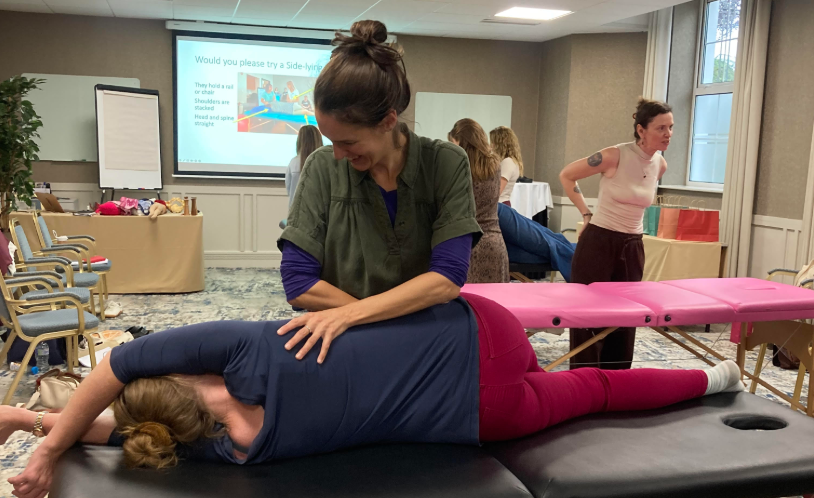
In addition to learning, the workshop provided an opportunity to meet other midwives and birth workers who were passionate about supporting positive experience of labour and birth for women. Meeting midwives from other NHS Trusts, who were being supported to train as a team, as well as midwives from other countries, working in units where Spinning Babies protocol were already established and sharing their first-hand accounts of the impact of the work was both encouraging and inspiring.
With levels of burnout high in the profession and more midwives leaving than joining, the landscape can sometimes feel bleak, but to meet these women alive with passion and enthusiasm, empowered by these tools to make a positive difference, helped me to feel recharged and renewed by the weekend.
Since qualifying as a midwife, having not yet rotated onto the labour ward, I haven’t had chance the to implement my new knowledge and the techniques gleaned from the course in practice. I have recently, however, had the opportunity to revise what I learnt that weekend through a presentation to my university’s midwifery society.
It feels important to share this knowledge with other students and newly qualified midwives, so that the awareness of how to support physiology in labour and birth is kept alive. I feel ready to start developing my practical skills on my next rotation - to the labour ward.
Alongside working part time at the Trust where I trained, this year I am also undertaking a Masters in Health and Social Care Research, supported by the National Institute for Health and Care Research. I hope to use this opportunity for further study to begin to contribute towards knowledge generation that will help to meet some of the current challenges in maternity care.
I am certain that labour biomechanics and optimal fetal positioning will continue to play a part in this.